
Yawata L-55 Welding Electrode — Why This E7016 Low Hydrogen Electrode Is Trusted by Singapore Fabricators

In Singapore's shipbuilding, structural steel, piping and infrastructure fabrication sectors, the choice of welding electrode for 490 N/mm² high tensile steel applications comes down to one requirement above all others: low diffusible hydrogen. Hydrogen-induced cold cracking — the most costly and difficult-to-detect weld defect in structural fabrication — is directly caused by elevated hydrogen in the weld deposit. The Yawata L-55 (AWS E7016) is a low hydrogen electrode purpose-built for exactly these applications.
Plony Industries is the exclusive Singapore distributor for Yawata welding electrodes — manufactured in Thailand by Yawata Electrode (Thailand) Co., Ltd., in partnership with Nippon Steel Welding and Engineering (Japan). The L-55 is our highest-volume electrode, trusted by fabricators across Singapore's marine, structural and piping industries for its consistent weld quality, X-ray acceptance rate and ease of use in all positions.
Who Is Yawata?
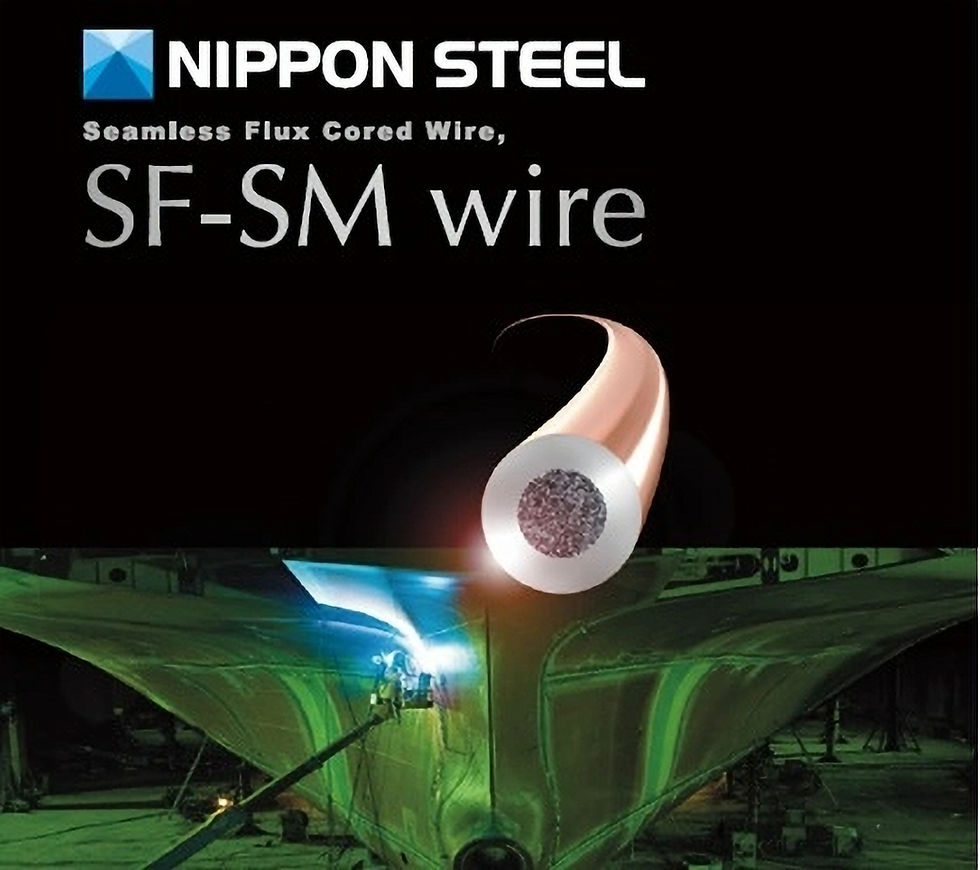
Yawata Electrode (Thailand) Co., Ltd. is a welding consumable manufacturer based in Thailand. What sets Yawata apart from generic electrode manufacturers is its technology partnership with Nippon Steel Welding and Engineering (NSWE) of Japan — the same company behind Nippon Steel's seamless flux cored wire technology and one of the most respected welding consumable R&D organisations in the world.
This partnership means Yawata's manufacturing process and product formulations incorporate Japanese welding technology standards — providing weld quality, consistency and mechanical properties that match or exceed internationally recognised benchmarks, at a competitive price point for Singapore fabricators.
Yawata electrodes are certified by internationally recognised bodies including Bureau Veritas, DNV, ABS and others — making them suitable for use in classification society surveyed vessels, certified structural fabrication and code-compliant piping projects.
Yawata L-55 — Full Product Profile
AWS Classification: E7016
The AWS E7016 classification tells the technical story of the L-55 directly:
• E — arc welding electrode (SMAW/stick process)
• 70 — minimum tensile strength of 70,000 psi (approximately 490 N/mm²) in the deposited weld metal
• 1 — all-position welding capability (flat, horizontal, vertical up and overhead)
• 6 — low hydrogen potassium coating with both AC and DC+ polarity capability
The low hydrogen coating is the defining characteristic of the E7016 class and the primary reason the L-55 is specified for structural, marine and piping applications where E6013 rutile electrodes are not suitable.
Key Performance Characteristics
Excellent crack resistance
The L-55's low hydrogen coating dramatically reduces diffusible hydrogen in the deposited weld metal — the root cause of hydrogen-induced cold cracking (HICC) in weld heat-affected zones. This makes the L-55 the correct electrode for high restraint joints, thick sections and 490 N/mm² high tensile steel where cold cracking risk is significant and weld repair is costly.
X-ray quality deposited metal
The L-55 produces clean, dense deposited metal with no porosity — meeting the radiographic acceptance criteria required for classification-surveyed shipbuilding, pressure vessel fabrication and certified structural steel projects. Fabricators and QC engineers in Singapore regularly specify L-55 specifically because of its consistent X-ray pass rate.
All-position capability — vertical and overhead welding are very easy
Unlike some low hydrogen electrodes that are primarily flat and horizontal position electrodes, the Yawata L-55 is engineered for easy vertical and overhead welding — a critical practical advantage in shipyard and structural steel environments where welders cannot always control joint orientation. The arc characteristics are stable and controllable in all positions without requiring significantly different technique from the welder.
Easy arc start — no porosity
The L-55 starts arc easily and consistently — no porosity is produced even at arc start. This is a meaningful quality advantage: arc start porosity is a common defect source in structural welding that requires grinding and re-welding. Consistent clean arc starts with the L-55 reduce this source of weld defects.
Suitable for AC and DC welding machines
The L-55 operates on both AC and DC+ (DCEP) welding power sources — making it compatible with the full range of welding machines in Singapore's fabrication shops, including older transformer-based AC sets commonly used in smaller workshops.
Yawata L-55 vs E6013 — When to Specify Which Electrode
The most common decision in Singapore's fabrication sector is when to use a low hydrogen electrode like the L-55 versus a rutile E6013 electrode. The answer depends on the base metal, joint configuration and quality requirements:
Factor | Yawata L-55 (E7016) | E6013 (e.g. Yawata S-13) |
AWS classification | E7016 | E6013 |
Coating type | Low hydrogen potassium coating | High rutile (titanium-potassium) coating |
Min tensile strength | 70,000 psi (490 N/mm²) | 60,000 psi (420 N/mm²) |
Diffusible hydrogen | Very low — H4 to H8 grade. Key advantage for crack-sensitive applications. | Higher — rutile coating absorbs moisture more readily |
Crack resistance | Excellent — low hydrogen dramatically reduces cold cracking risk | Moderate — suitable for mild steel, not for crack-sensitive applications |
X-ray quality | Excellent — clean, dense deposited metal with no porosity | Good — suitable for general applications but not critical NDT-inspected welds |
Welding positions | All positions — flat, horizontal, vertical and overhead | All positions except vertical downward (E6013 grade dependent) |
Base metal suitability | Mild steel and 490 N/mm² high tensile steel — ships, bridges, pipes, structures | Mild steel — light fabrication, sheet metal, general structural |
Storage requirement | Requires re-drying before use if stored in humid conditions — 300–350°C for 30–60 mins | More tolerant of ambient storage — re-dry at 70–100°C if moisture absorbed |
Ease of use | Good — easy arc start, easy vertical and overhead welding | Very easy — beginner-friendly, soft arc, self-lifting slag |
Best for | Structural steel, shipbuilding, pressure vessels, bridges, pipes — where crack resistance and X-ray quality are required | Light fabrication, general structural, sheet metal, repair work — where ease of use and bead appearance are priorities |
The Simple Rule
Use L-55 (E7016) when: You are welding 490 N/mm² high tensile steel, thick sections, high restraint joints or any application that requires NDT inspection, classification society survey or compliance with a welding procedure specification (WPS) that specifies low hydrogen consumables.
Use S-13 or FT-51 (E6013) when: You are welding mild steel in light to medium fabrication where ease of use, bead appearance and minimal operator skill requirements are the priority, and where NDT inspection and structural code compliance are not required.
Applications of Yawata L-55 in Singapore
Shipbuilding and Ship Repair
Singapore is one of the world's largest ship repair hubs — and the shipyard environment is where the L-55 performs at its highest volume in Plony's supply. Ship hull steel is typically AH32, AH36 or DH36 — all 490 N/mm² class high tensile structural steel requiring low hydrogen consumables and meeting Lloyd's, DNV, BV or other classification society requirements. The L-55 is a certified electrode for these applications.
• Hull fabrication and repair welding
• Deck plates and structural members in 490 N/mm² steel
• Pipe welding on vessels — including root pass applications with L-55W variant
• Repair and maintenance welding on classified vessels
Structural Steel Fabrication
Singapore's ongoing construction and infrastructure programme — MRT extensions, commercial developments, industrial buildings — generates continuous demand for structural steel welding. For structural members fabricated from S355 or equivalent 490 N/mm² steel, the L-55 provides the low hydrogen quality assurance that structural engineers and building authorities expect.
• Steel frames and columns in 490 N/mm² structural steel
• Beam-to-column connections in high restraint configurations
• Crane girders and heavy structural members
• Bridge structural components requiring certified weld quality
Large Diameter Pipe Welding
Large diameter pipe welding — for industrial process piping, structural piles, offshore jacket fabrication and similar applications — requires an electrode that produces clean, crack-free welds in all positions with consistent mechanical properties. The L-55 is specifically cited for large diameter pipe applications.
• Structural and industrial process piping in 490 N/mm² grade
• Offshore jacket and platform structural pipe
• Piling and foundation pipe welding
Bridges and Infrastructure
Bridge structural steel in Singapore is typically specified to BS EN 10025 S355 or equivalent — a 490 N/mm² class material requiring low hydrogen welding consumables. L-55 has been a standard bridge fabrication electrode across Southeast Asia for decades.
Yawata Electrode Range — Full Overview
While the L-55 is Plony's highest-volume Yawata electrode, the full Yawata range covers mild steel, high tensile and specialty applications:
Model | AWS Class | Type | Key Application |
S-13 | E6013 | High rutile | Mild steel sheet, pipes, light gauges, drums, structures and galvanised steel. Soft arc, self-lifting slag, beautiful bead. |
FT-51 | E6013 | High rutile | Mild steel for ships, rolling-stocks, structures and finished welding of heavy structural works. Stronger arc than S-13, vertical downward capable. |
L-55 | E7016 | Low hydrogen | 490 N/mm² high tensile steel for ships, structural steel, large diameter pipes and bridges. Excellent crack resistance and X-ray quality. All positions. |
L-55W | E7016 | Low hydrogen | One-side welding of pipes and 490 N/mm² high tensile steel for ships and pressure vessels. Stable arc for root pass welding with no blowholes. |
7018 | E7018 | Iron powder low hydrogen | 490 N/mm² high tensile steel for ships, steel frames, bridges and pressure vessels. Higher deposition rate than L-55. Excellent mechanical properties and X-ray quality. |
Contact Plony Industries for availability of all Yawata electrode grades in Singapore. Sample packs available for trial welding before bulk orders.
Storing and Using Low Hydrogen Electrodes — Practical Guide for Singapore
Low hydrogen electrodes like the Yawata L-55 are more sensitive to moisture than rutile E6013 electrodes. In Singapore's tropical climate — 80–85% average relative humidity — proper electrode storage is not optional. It is a quality requirement.
Storage
• Store sealed electrode boxes in a dry room at ambient temperature — do not leave opened boxes in the workshop overnight
• Opened boxes should be stored in an electrode oven at 50–70°C if not used within the same shift
• Never store low hydrogen electrodes on the workshop floor or in areas with water or condensation exposure
Drying Before Use
• If electrodes have been exposed to humid conditions or stored for extended periods, re-dry at 300–350°C for 30–60 minutes in a drying oven before use
• After drying, transfer to a portable holding oven or quiver at 70–100°C to keep electrodes dry during the welding shift
• Electrodes that have been wet or heavily moisture-contaminated should be discarded rather than dried — heavy moisture pickup cannot be fully reversed by drying
Signs of Moisture-Contaminated Low Hydrogen Electrodes
• Excessive spatter during welding
• Porosity in the weld — visible pinholes in the bead surface or on radiographic inspection
• Rough, uneven arc — the normally smooth L-55 arc becomes erratic
• Cracking sounds during welding
If any of the above occur with L-55 electrodes, suspect moisture contamination and dry the remaining electrodes before continuing. Contact Plony Industries if you need advice on electrode storage and handling for your specific workshop conditions.
Frequently Asked Questions — Yawata L-55 Welding Electrode Singapore
What is the Yawata L-55 welding electrode?
The Yawata L-55 is an AWS E7016 low hydrogen potassium-coated MMA (stick) welding electrode for all-position welding of mild steel and 490 N/mm² high tensile strength steels. It is manufactured by Yawata Electrode (Thailand) Co., Ltd. in partnership with Nippon Steel Welding and Engineering (Japan), and supplied exclusively in Singapore by Plony Industries.
What is the AWS classification of the Yawata L-55?
The Yawata L-55 is classified AWS E7016 — meaning it is an arc welding electrode with minimum 70,000 psi tensile strength deposited metal, all-position capability, and low hydrogen potassium coating compatible with both AC and DC+ welding power sources.
What is the difference between E7016 and E6013 electrodes?
E7016 (L-55) is a low hydrogen electrode with higher deposited metal strength (70,000 psi vs 60,000 psi for E6013) and dramatically lower diffusible hydrogen content. It is specified for 490 N/mm² high tensile steel, high restraint joints, NDT-inspected welds and structural applications requiring crack resistance. E6013 is a rutile electrode suited to mild steel light fabrication where ease of use and bead appearance are the priorities.
What applications is the Yawata L-55 used for in Singapore?
The Yawata L-55 is used in Singapore for shipbuilding and ship repair (hull steel AH32/AH36/DH36), structural steel fabrication (S355 and equivalent), large diameter pipe welding, bridge fabrication and any application involving 490 N/mm² high tensile steel requiring low hydrogen weld quality and NDT acceptance.
Does the Yawata L-55 work on AC welding machines?
Yes. The Yawata L-55 (E7016) operates on both AC and DC+ (DCEP) welding power sources — compatible with transformer-based AC sets and inverter-based DC welding machines commonly used in Singapore's fabrication workshops.
How should Yawata L-55 electrodes be stored in Singapore?
Low hydrogen electrodes should be stored in sealed boxes in a dry room. If exposed to Singapore's high humidity, re-dry at 300–350°C for 30–60 minutes before use. Store opened boxes in a holding oven at 70–100°C during the welding shift. Never store on wet or damp surfaces or leave opened boxes in the workshop overnight.
Where can I buy Yawata L-55 welding electrodes in Singapore?
Plony Industries is the exclusive distributor for Yawata welding electrodes in Singapore. We stock Yawata L-55 in standard diameters and can arrange sample packs for trial welding. Contact us at 6366 5855 or cs@plonyindustries.com for pricing and availability.
Buy Yawata L-55 Welding Electrodes in Singapore — Plony Industries
Plony Industries is the exclusive Singapore distributor for Yawata welding electrodes — manufactured in Thailand with Nippon Steel Welding and Engineering (Japan) technology. We stock Yawata L-55 and the full Yawata electrode range for immediate supply to Singapore's fabrication, shipbuilding and construction industries.
• Yawata L-55 (E7016) — low hydrogen electrode for 490 N/mm² high tensile steel
• Yawata S-13 (E6013) — high rutile electrode for mild steel and light fabrication
• Yawata FT-51 (E6013) — high rutile electrode including vertical downward
• Yawata 7018 (E7018) — iron powder low hydrogen for higher deposition rate
• Sample packs available for trial welding before bulk orders
• Ready stock — island-wide delivery across Singapore
Contact Us: +65 6366 5855 | cs@plonyindustries.com
Welding Filler Metals: www.plonyindustries.com/welding-filler-metal-singapore
Related Articles and Pages
• Welding Filler Metals Singapore — Full Range: www.plonyindustries.com/welding-filler-metal-singapore
• Welding Machine Singapore — MIG, TIG, MMA and Robotic Welding: www.plonyindustries.com/welding-equipment
• Yawata Welding Electrodes Overview: www.plonyindustries.com/post/yawata-welding-electrodes


Comments